The Truth About the San Diego Median Home Price
5-minute read
Every month you get a headline or you see a post on social media that tells you what "the median San Diego home" sold for and how much it's gone up or down in a specific period of time. Then they like to compare San Diego to San Francisco and LA and New York and which one of those cities we've surpassed or fallen under.
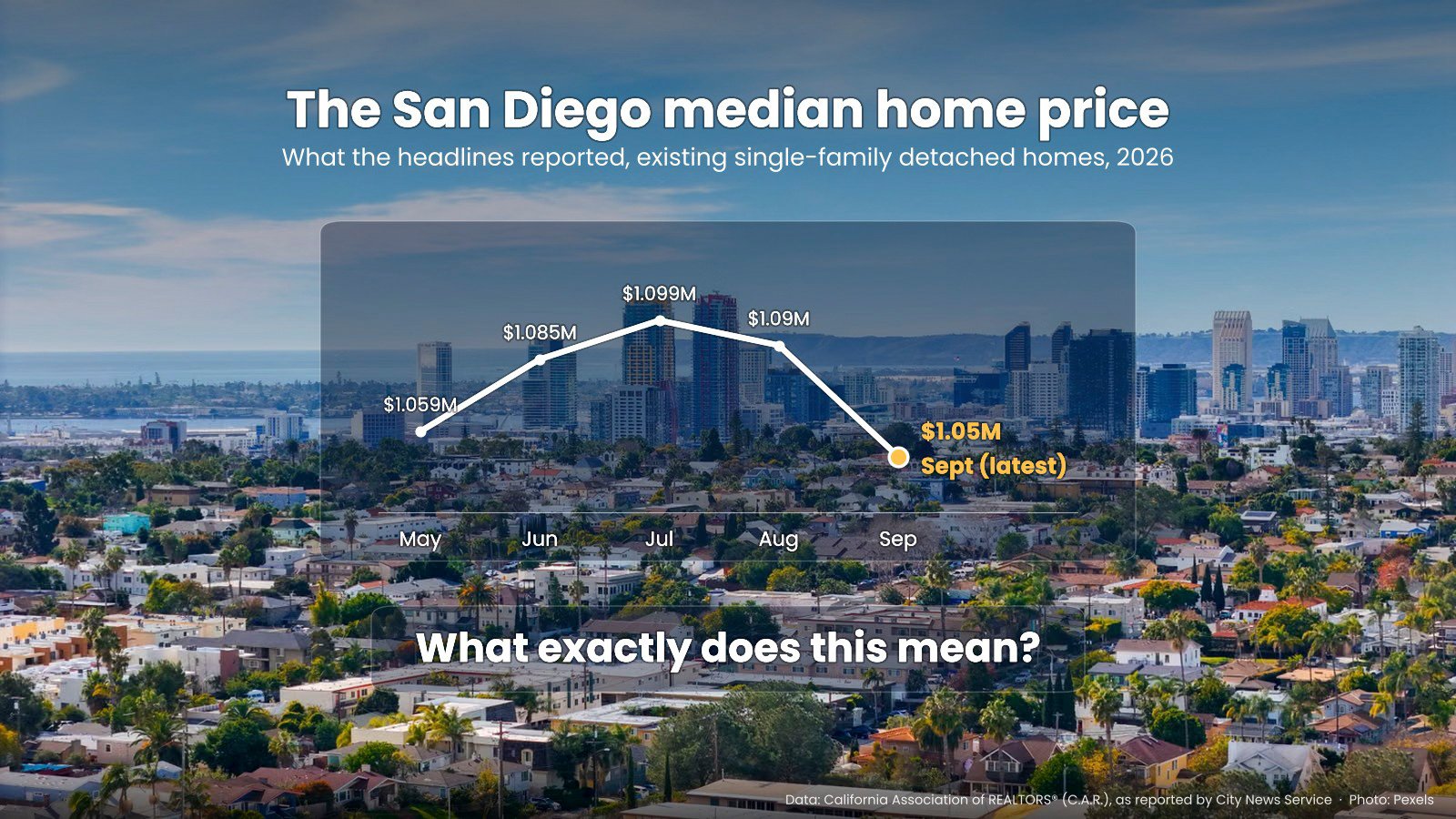
In September 2026, the San Diego County median was $1,050,000. One headline said that was up 6.1% from a year earlier. Another said San Diego prices fell 3.7% and called the very same number the "average." Both were describing one median: higher than last September, lower than August.
So which is it? Did your home go up or down? And what does the median home price even mean and why is it important to you? It's not. Honestly, probably neither number can tell you. Here's why, and what to look at instead.
Line up every home that sold, from cheapest to most expensive. The median is the house right smack in the middle. The average is the total of all the prices of sold homes, divided by the number of sold homes.
Picture five sales on one street: a $650,000 two-bedroom cottage, a $720,000 small three-bedroom house, a $780,000 ranch style house that hasn't been remodeled or updated, an $810,000 two-story house and a $2.4 million house that was remodeled and flipped. The median is $780,000. The average is $1,072,000, even though four of the five homes sold for under $820,000. One big sale drags the average up. That's why the industry reports medians instead of averages. But even the median has a big blind spot, and it's why these articles say almost nothing about your home.
Here's the catch. The county median isn't the value of a typical home. It's the price of the middle home among the ones that happened to sell that month, everywhere from Coronado to Campo, from 900-square-foot cottages to hilltop estates with ocean views.
Even the California Association of REALTORS®, which publishes these numbers, cautions that a change in the median shouldn't be read as a price change in specific homes.
Back to that street. Say next month a different five homes sell, and they happen to be bigger: $810,000, $900,000, $950,000, $2.4 million and $2.5 million. The median jumps from $780,000 to $950,000, a 22% "gain." But no home on the street is worth a dollar more. Only the mix of homes that sold changed.
This happens across the county all the time. In winter, for example, fewer expensive suburban homes sell, so the median can dip even when values hold. Economists call it mix shift, and it's why Zillow and Case-Shiller built indexes that follow the same homes over time.
One place the median does show up in your home purchase is your loan. Each year, the Federal Housing Finance Agency sets a "conforming loan limit" for every county, and in higher-cost areas like San Diego it's based on the local median home value. If you borrow above that limit, your loan is usually considered a jumbo loan, which can come with different rates, down payment requirements and qualifying rules. (Fun fact: the median the government uses isn't even the same one you see in the headlines.)
Whether any of this applies to you depends on your price range, your down payment and the type of loan you choose, and that's a conversation for a lender, not a headline. A few good questions to ask your loan officer: "What's this year's conforming limit for the county I'm buying in? How close will my loan amount be to it? And how do the rates and requirements compare on either side of it?" If you'd like an introduction, I work with a few lenders I trust and I'm happy to connect you.
The problem isn't the median. It's the group of homes it's taken from. A median of every home in the county tells you about the county. A median of homes like yours tells you about your home. When I price a home, I build that like-for-like comparison:
From that set I look at various numbers and other factors from various sources that are important in your market. I then walk through the home, because updates, views and layout are also factors that explain where yours lands in that range.
I used to do home valuations for the U.S. Bankruptcy Court for the Southern District of California, for attorneys and trustees. I have been doing home valuations for clients and investors for the past 21 years. If you're curious what your home would sell for, not the county median, I'll put together a like-for-like comparison and walk you through it in about 20 minutes. Call or text me at 619-737-6586.
Jerome Morlet | REALTOR® | DRE# 01795086 | Canter Real Estate Group | Compass
Sources: California Association of REALTORS®, how the median is defined; C.A.R. September 2026 county figures, via Norada; City News Service via 10News, September 2026; Zillow Home Value Index methodology; S&P Cotality Case-Shiller San Diego index; Federal Housing Finance Agency, conforming loan limits; Redfin housing market data.
Stay up to date on the latest real estate trends.
Why the "median home price" says almost nothing about your home

Discover La Mesa’s charm with walkable streets, local shops, friendly neighborhoods, and easy access to San Diego amenities.

Explore North Park’s vibrant mix of craft breweries, artsy vibes, walkable streets, and popular dining spots.

A side-by-side look at San Diego and Los Angeles to help homebuyers compare prices, lifestyle, commutes, and housing options.

Experience Pacific Beach living with ocean views, sandy beaches, active nightlife, and a relaxed Southern California vibe.
Whether buying, selling, investing, or developing, Jerome provides expert guidance, strategic insights, and personalized service to help clients navigate San Diego’s real estate market with confidence. Partner with him to turn your real estate goals into reality.
Jerome Morlet | CA DRE# 01795086
7863 Girard Ave #210 San Diego, CA 92037